
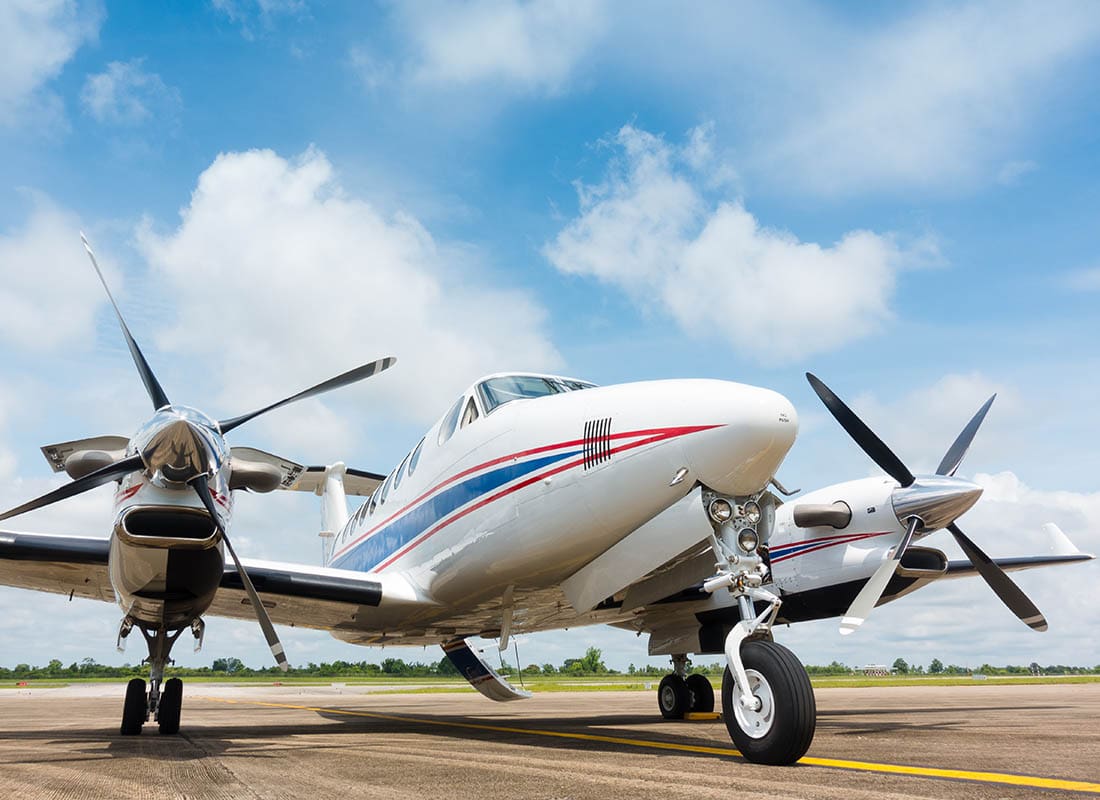
From the hangar to the runway, cover your business with aviation insurance.
Coverage based on the size of your aviation operation.
Different types of aviation operations require different coverage. Commercial airports, municipal airports, and private airstrips don’t have the same needs. Employee responsibilities can range from operations to mechanics to pilots. These are all considerations to account for when selecting an aviation insurance policy.
Protection for situations in the air.
There’s no one-size-fits-all aviation coverage, so having protection for the situations that your aviation business is at risk for is important. Whether transporting people or cargo, there’s an obligation to deliver everyone and everything safely. Liability needs can vary greatly from one business to the next. Here are some of the various coverage options that your aviation business might want to consider.
- Passenger Liability Insurance
- Hull Insurance
- Hangar Keepers Insurance
- Non-Owned Aircraft Insurance
Interactive Graphic

General Liability
Risk Factor
Flying an aircraft comes with some inherent risks, not only to the person operating an aircraft and its passengers but also to the general public. If there is a mishap that involves damage to property or the general public you, as the pilot in command, are liable to the public.
Solution
Public liability insurance, often referred to as third-party liability, covers aircraft owners for damage that their aircraft does to people to people and property, not including the passengers on the aircraft.
Passenger Liability Insurance
Risk Factor
Whether you are in the business of transporting people or you simply like to take people for rides to share the joy of flight with them, as the pilot in command, you are taking on the responsibility for their safety. Hold harmless and liability waivers are of little protection, if any, for pilots.
Solution
Passenger liability insurance protects passengers riding in the accident aircraft who are injured or killed. Coverage is often sold on a per-seat basis, with a specified limit for each passenger seat.
Non-Owned Aircraft Insurance
Risk Factor
Borrowing or renting an aircraft? Taking flying lessons? Chances are you still have a risk exposure that may not be covered by the aircraft owner’s insurance.
Solution
Non-owned aircraft insurance protects you from legal obligations that may arise out of operating an aircraft you do not own. In addition, it provides for extra expenses including search and rescue, emergency flight coordination, legal expenses, and more.
Hull Insurance
Risk Factor
Aircraft are very expensive, as are repairs to them. Strict regulations require planes to be in a certain condition in order to fly. One brush against a hangar or other damages to your aircraft can lead to some very large repair bills.
Solution
Hull insurance protects your aircraft in case of damage. There are different types, such as in motion and not in motion, as well as full flight protection. Premiums and deductibles on hull insurance can vary based on the value of the aircraft.
Hangar Keepers
Risk Factor
Hangar owners face unique risks for property in their care, custody or control, as well as the hangar itself.
Solution
Hangar keepers insurance provides protection to the owner of the hangar for the building and the contents of others inside the hangar. It can also provide coverage for tools and equipment. Hangar keepers can be a standalone coverage or part of an airport’s insurance package.
Workers' Compensation
Risk Factor
If one of your employees receives an injury or becomes ill due to a work-related occurrence, you are required by law to have the proper coverage in place. Working with tools, machinery, and aircraft can be an even riskier occupation than most.
Solution
Workers' compensation protects your employees should a job-related injury or sickness occur during the course of employment. This coverage is required by law, so be sure that you have it. Placing workers’ compensation for an aviation operation can be particularly difficult, so having an insurance advisor who understands the industry is crucial.
Employment Practices Liability Insurance (EPLI)
Risk Factor
On average, it's estimated that three out of five businesses will be sued by their employees. Companies are vulnerable during the pre-hire process, throughout employment, and during a reduction in workforce. Claims can also be made by clients or potential clients and can arise in any size operation. You can do everything right and still be sued.
Solution
Coverage to protect you against this risk normally comes as a standalone policy. The right coverage is critical to your risk management process as it protects against discrimination, wrongful termination, sexual harassment, and other employment-related allegations. Typically, the policy will cover your business as well as your directors and officers. Third-party coverage is an added option, usually accomplished via a policy endorsement, and addresses claims made by customers or vendors against you from acts committed by employees.
Cyber Liability
Risk Factor
The internet has spun a whole new web of liability exposures. E-commerce, social networking, cloud storage, and other technologies bring great benefits to all businesses. But with these benefits also come challenges, including protection of privacy, data, and financial information of your employees and students.
Solution
Cyber liability coverage covers unauthorized access to electronic data or software within your network. It also provides coverage for spreading a virus, computer theft, extortion, or any unintentional act, mistake, error, or omission made by an employee. This coverage is quickly becoming more and more important as you embrace technology.
Umbrella / Excess Liability
Risk Factor
What happens when your operation faces a large liability loss that exceeds the basic limit of your standard policy?
Solution
A commercial umbrella policy provides high limits of insurance, typically between $2,000,000 and $10,000,000. Coverage is extended over your general liability insurance, workers' compensation, business auto, as well as directors and officers liability coverage. It provides a great safety net and helps ensure your business is well protected.
What’s included in your aviation insurance policy?
Aviation operations also need to insure their facilities and everything inside. This includes buildings, equipment, and inventory. Whether flying is all you do or just a part of a larger organization, aviation insurance helps bring protection and peace of mind so you can focus on your business. And since you’re running a business, you may also need coverages such as workers’ compensation, general liability, cyber liability, and business auto insurance.
To learn more about how aviation insurance may benefit your operation, contact us to go over your needs and your coverage options.
Let’s Get Started
Aviation Insurance Quote Request
"*" indicates required fields
Don’t like forms? Contact us at or .
Frequently Asked Questions
What does aviation insurance cover?
A standard aviation insurance policy typically provides two core protections: Hull Coverage (for physical damage to the aircraft itself) and Liability Coverage (for third-party bodily injury and property damage). Depending on your operation, you can tailor your policy to include:
- Passenger Liability: Protection specifically for those on board.
- Hangar Keepers Liability: For damage to aircraft in your care, custody, or control.
- Medical Payments: No-fault coverage for minor injuries to passengers or crew.
- Optional Riders: You can add non-owned aircraft liability, workers’ compensation, cyber liability, and umbrella limits to address specialized risks.
How much does it cost to insure a Cessna 172 or any small plane?
In 2026, the annual cost to insure a light single-engine aircraft like a Cessna 172 generally ranges from $800 to $3,500. Your specific premium is driven by:
- Pilot Experience: Higher flight hours and advanced ratings (like an Instrument Rating) significantly lower your rates.
- Hull Value: Premiums for physical damage typically range from 1% to 2.5% of the aircraft’s “Agreed Value.”
- Usage: Personal and recreational flying is the most affordable, while flight instruction or commercial charter use increases premiums.
- Storage: Keeping your plane in a hangar rather than at an outdoor tie-down can lead to lower rates by reducing weather-related risk.
Do I need insurance if I rent or borrow a plane?
Yes. While the aircraft owner or flight school likely has insurance, that policy is designed to protect their interests, not yours. If you are involved in an incident, the owner’s insurance company may pursue you personally to recover its costs, a process called subrogation. Non-Owned Aircraft Insurance (often called Renters Insurance) is an affordable way to protect your personal assets, cover the owner’s deductible, and provide for your legal defense if you are sued.
Is aviation insurance required by law?
Unlike auto insurance, there is no federal FAA requirement for private aircraft insurance in the U.S. However, insurance is mandatory in practice for almost every operator because:
- Lenders: If you have a loan on your plane, the bank will require full hull and liability coverage.
- Airports & FBOs: Most hangars and airports require a minimum of $1,000,000 in liability coverage to use their facilities.
- Commercial Operations: If you fly for hire (Part 135), the DOT mandates specific minimum liability limits per passenger.
Does aviation insurance cover drones or unmanned aircraft?
Standard “manned” aircraft policies usually exclude unmanned aerial vehicles (UAVs). However, as of 2026, most aviation brokers offer specialized Drone Insurance that covers:
- Commercial Liability: Often required by clients ($1M+ limits) for aerial filming, inspections, or mapping.
- Hull & Payload: Protection for the drone itself and expensive mounted sensors (LiDAR, thermal cameras).
- Ground Equipment: Coverage for controllers, base stations, and tablets used in flight operations.
